Key takeaways
- Price from your cost of doing business, not from competitors' rate cards.
- Base day rate = (yearly overheads + your salary) ÷ shoot days you can sell.
- Add per-package direct costs and a 15–25% margin.
- Offer three tiers, sell the middle one, and remove deliverables instead of discounting.
- Show GST separately and take an advance to block the date.
01Why copying the studio down the road fails
Most photographers in India set prices the same way: ask around, look at a few Instagram rate cards, and quote a little less. It feels safe, but it ignores the only numbers that decide whether your business survives: your costs and your calendar.
The studio you are copying may own its building, run a five-person crew, or simply be losing money. Undercutting them starts a race to the bottom where nobody can afford better gear, a second shooter or a day off. Price is also a signal: clients who see the cheapest quote often assume the cheapest work.
The fix is a simple, repeatable method. You need last year's expenses, a calculator and about an hour.
02Step 1: work out your cost of doing business
Your cost of doing business (CODB) is everything it takes to keep the studio open for a year, whether or not you shoot. List it honestly. Here is an example for a small studio with one main photographer:
| Yearly cost | What it covers | Example |
|---|---|---|
| Gear | Bodies, lenses, lights and drives, replaced about every 4 years (₹6 lakh of kit ÷ 4) | ₹1,50,000 |
| Studio | Rent, electricity, internet | ₹1,80,000 |
| Software & storage | Editing software, cloud storage, website, studio software | ₹40,000 |
| Marketing | Ads, sample albums, printed material | ₹60,000 |
| Repairs & insurance | Servicing, sensor cleaning, gear insurance | ₹30,000 |
| Unbilled travel | Recces, client meetings, trips you don't charge for | ₹40,000 |
| Accountant | Bookkeeping, GST filing, income tax | ₹15,000 |
| Overheads | ₹5,15,000 |
Example figures only. Use your own; they will differ by city, gear and team.
Now add the part most photographers forget: your own salary. If you want to take home ₹50,000 a month, that is ₹6,00,000 a year. In this example the studio has to earn ₹11,15,000 a year before it makes a rupee of profit.
03Step 2: count the days you can actually sell
A shoot day is never one day. Every event brings culling, editing, album design, client calls, backups and delivery: often two or three more days of work. Add travel, the off-season and the weeks when the calendar is simply empty, and a solo photographer sells far fewer shoot days than they expect.
Look at last year's calendar, be honest, and divide:
Example: (₹5,15,000 + ₹6,00,000) ÷ 60 days = ₹18,583, so about ₹18,600 per shoot day
If your current full-day price is below your base day rate, every booking loses money, even before you pay a second shooter or print an album. Fixing this is the biggest raise you will ever give yourself.
Notice how sensitive the number is. At 40 sellable days the same studio needs ₹27,875 a day; at 80 days, ₹13,938. Filling the calendar and charging properly are two sides of the same equation.
04Step 3: add per-shoot costs and a margin
Your base day rate pays for the studio and for you. Each package also has direct costs that only exist because of that booking:
- Second shooters, assistants and videographers
- Outsourced editing or album design
- Album printing, prints and frames
- Travel, stay and food outside your city
- Drone operators, extra lighting or rentals
Finally, add a margin of 15–25%. Margin is not greed: it pays for slow months, new gear and the mistakes every season brings. A worked example for a three-function wedding:
| Line | Calculation | Amount |
|---|---|---|
| Coverage | 3 shoot days × ₹18,600 | ₹55,800 |
| Assistants | 2 assistants × 3 days × ₹3,000 | ₹18,000 |
| Album | 40-sheet album, printing and box | ₹12,000 |
| Local travel | Fuel, parking, transport | ₹5,000 |
| Subtotal | ₹90,800 | |
| Margin | 15% of subtotal | ₹13,620 |
| Package price | ₹1,04,420, rounded | ₹1,05,000 + GST |
05Step 4: build three tiers and sell the middle
Clients rarely want the cheapest or the most expensive option. Give them three clear choices and most will pick the middle one. The top tier makes the middle look reasonable; the bottom tier keeps budget enquiries in the conversation without dragging your main price down.
Build every tier with the same method, so each one is profitable on its own. An example rate card across different kinds of shoots:
| Package | What's included | Example price |
|---|---|---|
| Portrait, maternity or baby | 2–3 hours, one location, 40 edited photos, online gallery | ₹11,000 |
| Corporate event, half day | 4 hours, live upload during the event, face-search gallery for attendees | ₹14,000 |
| Pre-wedding or couple shoot | 1 day, 2 locations, assistant, 60 edited photos | ₹28,000 |
| Wedding · Essential | 3 functions, 1 assistant, online selection, e-album | ₹80,000 |
| Wedding · Signature | 3 functions, 2 assistants, 40-sheet album, face search for guests | ₹1,05,000 |
| Wedding · Luxe | Signature plus a cinematic film team, drone and express delivery | ₹1,65,000 |
Example prices before GST, worked out from the ₹18,600 base day rate above. Yours will be different.
Name tiers after outcomes, not sizes. “Essential, Signature, Luxe” sells better than “Basic, Standard, Premium”, and nobody wants to book “Basic” for their wedding.
06Step 5: add-ons that raise the average booking
Add-ons let clients upgrade without you cutting the core package. Price each one with the same cost-plus-margin logic:
- Extra hours and extra functions
- A second shooter or a candid specialist
- Album upgrades: more sheets, premium covers, parents' albums
- A same-day edit or a 60-second teaser reel
- Express delivery of selected photos
- Drone coverage, where it is permitted
- Prints and frames for the family
There is also income that costs the client nothing: with paid photo downloads, guests buy the candids that never make the album.
07How to present the price
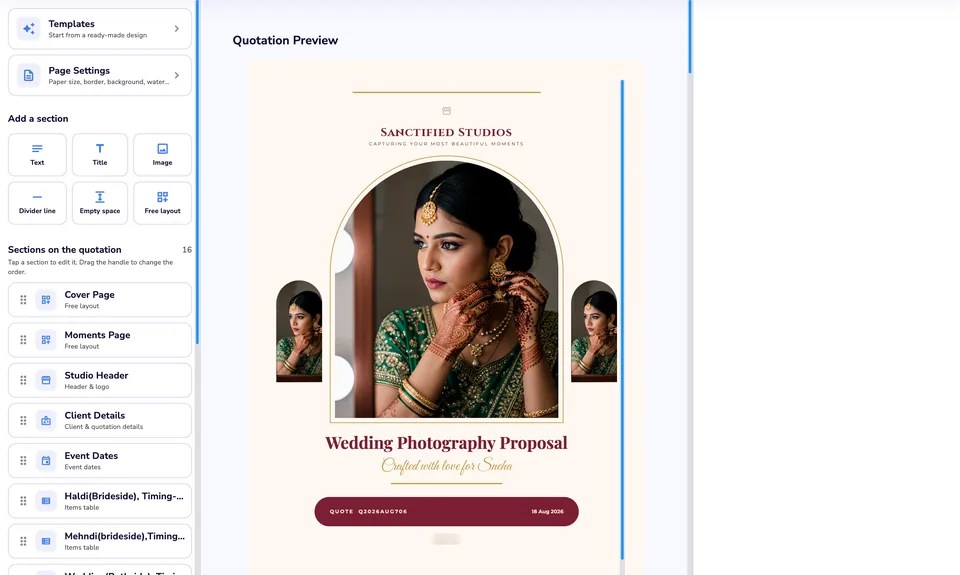
A bare number on WhatsApp invites haggling. A designed proposal that lists every function, deliverable and timeline justifies the number before the client asks. Our quotation format guide walks through the layout. Five rules that hold for every genre:
- Lead with the outcome, then the coverage, then the price.
- List deliverables with timelines: number of edited photos, album size, delivery date.
- State validity. “This quotation is valid for 15 days” creates gentle urgency.
- Write your terms once and attach them every time: overtime, travel, cancellation, delivery.
- Set a payment schedule. Many studios take 30–50% to block the date, the next instalment before the event and the balance before final delivery.
08Discounts, negotiation and raising prices
Don't discount; remove. When a client says the price is too high, offer a smaller package (fewer hours, one photographer, a smaller album) instead of the same work for less. Your rate stays intact and the client still gets a yes.
To fill quiet dates, publish off-season or weekday pricing that is predictable, rather than a secret discount for whoever pushes hardest.
Review prices once a year, before the season. Two signs you are too cheap: your calendar fills months ahead, and almost every quotation turns into a booking. Track quotations sent against quotations booked; a very high conversion rate usually means there is room to raise prices.
09GST and the paperwork
Photography services attract 18% GST. Registration becomes mandatory once your aggregate turnover crosses ₹20 lakh in a financial year (₹10 lakh in special category states), and you can register voluntarily before that. Rules change, so confirm the details with your CA.
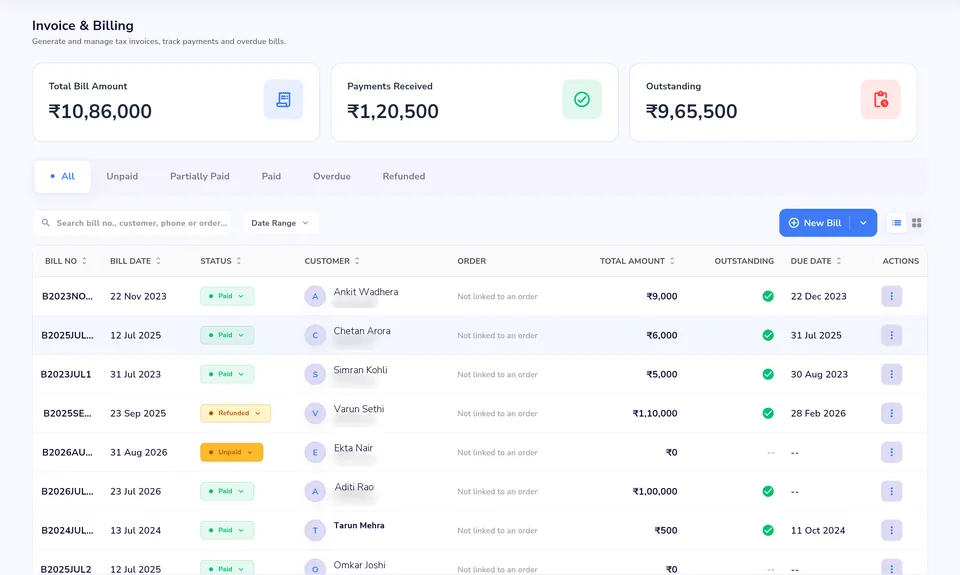
If you are registered, quote prices as “₹1,05,000 + 18% GST” so clients see exactly what they pay for. Our guide to GST bills, receipts and payment QR for photographers covers invoicing.
10Track whether your prices actually work
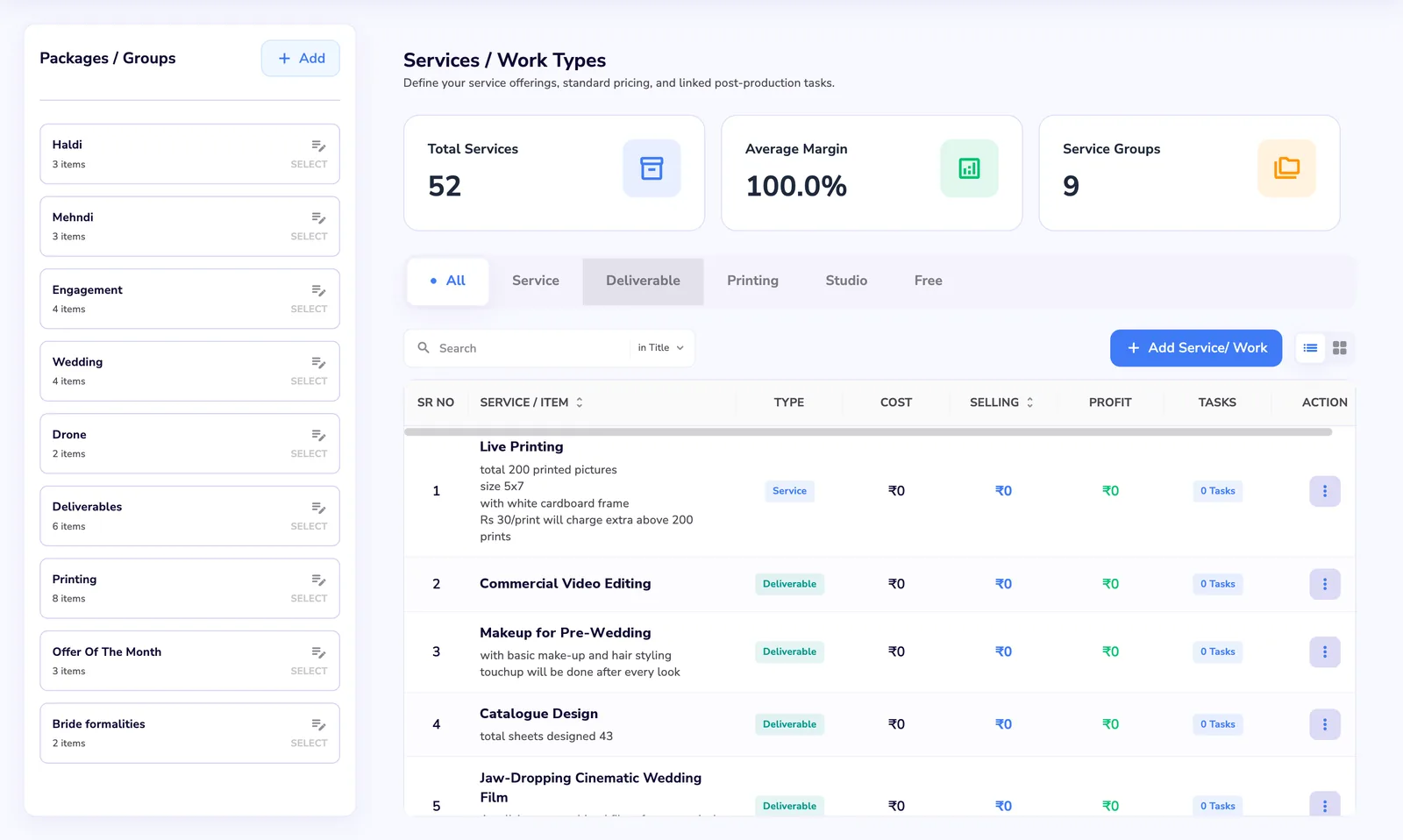
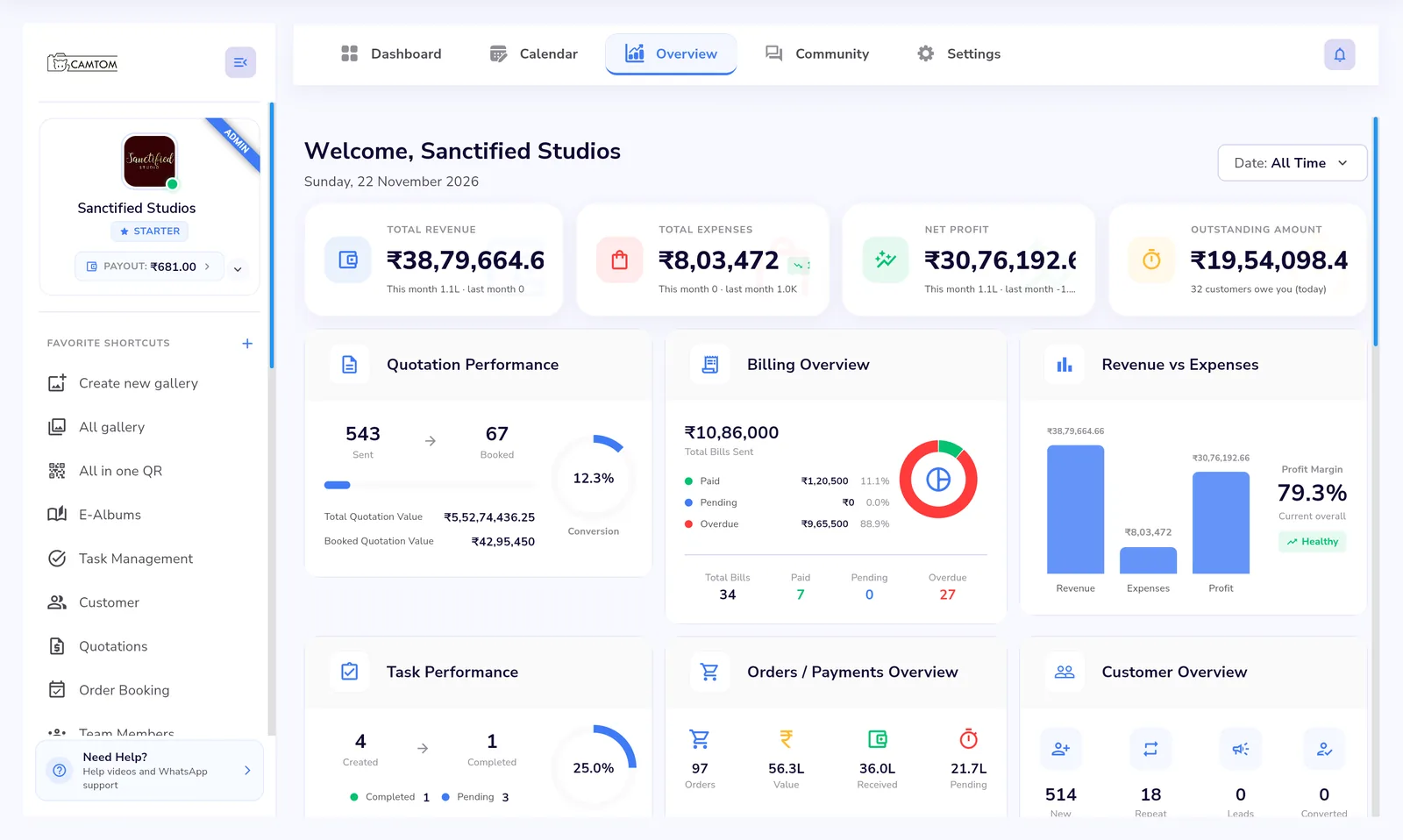
A rate card is a hypothesis. After every event, check what it really cost and earned. In Camtom, Services & packages store every service, deliverable and print item with its cost, selling price and profit, grouped into packages, and Reports show event profitability and expense analysis, exportable as PDF or Excel for your CA.
Do this for one season and you will know, not guess, which packages make money.
Camtom's photography CRM keeps leads, quotations, bookings, invoices, payment QR codes and your team in one app, together with client photo selection.
11Frequently asked questions
How much should a photographer charge per day in India?
There is no single right number: it depends on your costs, your salary and how many days you can sell. Work out your base day rate as (yearly overheads + your salary) divided by sellable shoot days. In our example, a small studio needs about ₹18,600 per shoot day before per-event costs.
Should I show my prices on my website or Instagram?
Showing “starting from” prices filters out enquiries that will never fit your budget, while leaving room for a tailored quotation after a call.
How much advance should a photographer take?
Many studios take 30–50% to block the date, with the balance due before final delivery. Whatever you choose, put it in your written terms.
Should GST be included in my package price?
If you are GST-registered, show it separately, for example “₹1,05,000 + 18% GST”, so packages stay easy to compare and clients see the tax clearly.
How often should I raise my photography prices?
Review them once a year, before the season. Raise them sooner if your calendar fills months ahead or nearly every quotation converts into a booking.